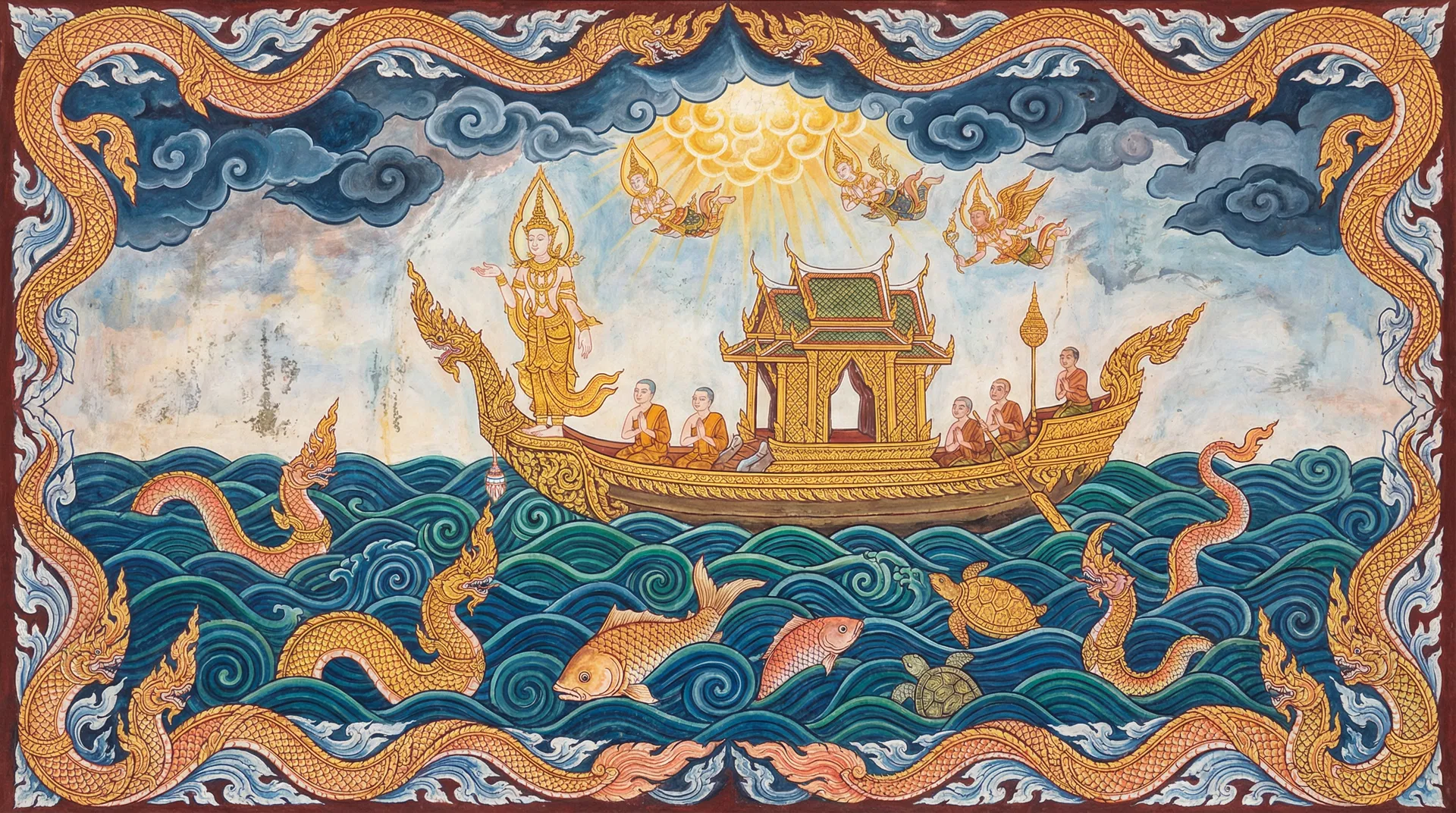
Somanassa Jātaka
The Tale of the King of the Gods and the Benevolent King
In the celestial realm of Tavatimsa, ruled the mighty Sakka, King of the Gods. His throne was adorned with jewels, his domain stretched across the heavens, and his power was immense. Yet, even in such a glorious realm, Sakka was not without his concerns. He watched the mortal world with a keen eye, observing the deeds of kings and commoners alike, for the state of the heavens was inextricably linked to the merit and virtue of beings on earth.
At this time, on the terrestrial plane, there reigned a wise and virtuous king in the land of Kāsi. His name was King Somanassa, and his reign was a beacon of peace and prosperity. He ruled not with an iron fist, but with a heart filled with compassion and a mind dedicated to justice. His subjects adored him, for he ensured that everyone, from the humblest farmer to the highest noble, lived without fear and with dignity.
King Somanassa practiced the ten royal virtues with unwavering devotion. He was generous, giving freely to the needy. He was moral, upholding the five precepts with his life. He was selfless, putting the welfare of his people above his own comfort. He was patient, enduring hardship with grace. He was truthful, never uttering a falsehood. He was forgiving, holding no grudges. He was peaceful, seeking to resolve conflicts through dialogue. He was resolute, steadfast in his commitment to righteousness. He was benevolent, extending kindness to all beings. And he was equanimous, treating everyone with impartiality.
Sakka, observing King Somanassa’s virtuous deeds, was deeply impressed. He saw that the King’s merit was so great that it caused the celestial flowers in Tavatimsa to bloom with unusual brilliance, a sign that a great benefactor walked the earth. Yet, Sakka, being a god of immense power, also knew that even the most virtuous can face trials. He decided to test King Somanassa, to see if his virtue would hold firm even under the most severe adversity.
One day, a fierce drought struck Kāsi. The rivers dwindled, the fields cracked, and the people began to suffer. Famine loomed. King Somanassa, distressed by his people’s plight, doubled his efforts. He opened his royal granaries, distributing food to the starving. He ordered the digging of new wells, even as the earth yielded little water. He prayed for rain, his heart heavy with concern.
Despite the King’s efforts, the drought persisted, and desperation grew. Seeing this, Sakka, disguised as a humble ascetic, approached the King’s palace. He presented himself before King Somanassa, his voice frail. “O King,” he said, “I have traveled far and wide, and I hear you are a king of great generosity. I am starving, and I beg you for a meal.”
King Somanassa, though his own resources were stretched thin, did not hesitate. “Venerable sir,” he replied, “I have little left, but I will share what I have. Come, partake of the last of my royal provisions.” He personally served the ascetic, offering him the choicest morsels, though he himself ate sparingly.
As the ascetic finished his meal, he looked at the King with an unsettling gaze. “Your Majesty,” he said, “you have shown me great kindness. But my hunger is not yet fully satisfied. I desire something even more precious than food. I desire the flesh of your own body. Give me a piece of your flesh, and I shall be truly content.”
The King, for a fleeting moment, was taken aback. This was a demand unlike any he had ever heard. But then, he recalled his vow to help all beings, to practice compassion without limit. He looked at the ascetic, seeing not a tormentor, but a suffering being. “If my flesh can alleviate your suffering, then I shall gladly give it,” he said calmly. He ordered a sharp knife and, with his own hand, cut a piece of flesh from his thigh. He offered it to the ascetic, who consumed it as if it were the finest delicacy.
Sakka, witnessing this ultimate act of selflessness, was overcome with awe. The celestial flowers in Tavatimsa burst into radiant bloom, their fragrance filling the heavens. Sakka then revealed his true form, shining with divine radiance. “King Somanassa,” he declared, his voice resonating with divine power, “your virtue is indeed boundless. You have passed the greatest test. Your compassion knows no limits. Your generosity is unparalleled. You have shown the world what true kingship means.”
Sakka then used his divine power to instantly end the drought. Rain poured down upon Kāsi, nourishing the parched land. The rivers swelled, the crops revived, and the people rejoiced, their suffering relieved. The King, though wounded, felt no pain, only the profound joy of having fulfilled his duty and brought relief to his kingdom. From that day on, King Somanassa’s fame spread even further, a testament to his unwavering commitment to righteousness and compassion. Sakka, the King of the Gods, continued to watch over him, knowing that such a virtuous soul was a true guardian of the world.
True compassion and generosity extend even to the point of self-sacrifice, demonstrating an unwavering commitment to the well-being of others. Such virtue brings immense merit and relief from suffering.
— In-Article Ad —
💡Moral of the Story
Boundless compassion and selflessness, even in the face of extreme adversity, are the hallmarks of true virtue and leadership.
Perfection: Generosity (Dāna), Morality (Sīla), and Patience (Khanti)
— Ad Space (728x90) —
More Jataka Tales You May Enjoy
 6Ekanipāta
The Compassionate Elephant
The Compassionate ElephantIn the heart of a vast, sun-drenched savanna, where acacia trees dotted th...
💡 True compassion demands the greatest sacrifice, and love can transform the world.
 189Dukanipāta
Sujana Jataka
The Tale of the Kindhearted KingIn the opulent kingdom of Mithila, a land blessed with fertile plain...
💡 True leadership and genuine kindness are demonstrated through selfless generosity and a profound commitment to the welfare of others, even at great personal cost.
211DukanipātaKhaggavisana Jataka
The Horned Solitary OneIn the ancient city of Mithila, nestled amidst lush gardens and bustling mark...
💡 True happiness and peace are found through inner cultivation, detachment from worldly desires, and self-reliance, much like a solitary rhinoceros finds strength in its own horn.
 255Tikanipāta
Sattigumba-Jātaka
Sattigumba-JātakaIn the sprawling kingdom of Kasi, renowned for its skilled artisans and vibrant mar...
💡 True magnificence and strength lie in compassion, respect for nature, and harmonious coexistence, not in dominance or possession. Righteous rule is demonstrated through justice, empathy, and the protection of all living beings.
233DukanipātaPhra Ong Khon Duang Chan (The Bodhisatta as a Celestial Being Who Manifested as a Moonbeam)
Phra Ong Khon Duang Chan (The Bodhisatta as a Celestial Being Who Manifested as a Moonbeam) High abo...
💡 Compassion, even in its most subtle forms, has the power to bring forth life and renewal, transforming despair into hope and offering solace to those in need.
165DukanipātaMahasattva Jataka
The Bodhisatta's Compassion for the Hungry TigressIn the vast, untamed wilderness of the Himalayas, ...
💡 The highest form of compassion is selfless sacrifice, willing to give one's own life for the well-being of others, even for animals, to alleviate suffering and demonstrate ultimate love.
— Multiplex Ad —